
Reviewed · WALKING TOURS
Walking Tour in Florence: 2-Hour Private walking tour
A private 2-hour walking tour is one of the fastest ways to make Florence click, because you see the main sights in sequence and you get the stories that connect them. I especially love how the route moves from Piazza della Repubblica to the Duomo area and on to the Arno, so you understand the city’s layout without getting lost. The one drawback to plan around is simple: it is a straight walking day, so comfortable shoes matter, and you will be outside for most of it.
My favorite part is that this feels personal. Your guide is Irina, and her style is relaxed, conversational, and tuned to your questions, so you are not just collecting photos. If you are hoping to spend most of your time inside major sites, this is more of a streets-and-squares tour, with key buildings usually viewed from the outside.
Quick hits if you only read one section
- Private, in English, with your group only, so you can go at a comfortable pace
- Rome to Renaissance on foot, starting at Piazza della Repubblica and ending at Ponte Vecchio
- Duomo and Baptistery context without rushing, including the Gates of Paradise seen from the outside
- Dante’s neighborhood stop, tied to his life and language
- Signoria and Palazzo Vecchio area, including the open-air sculpture square
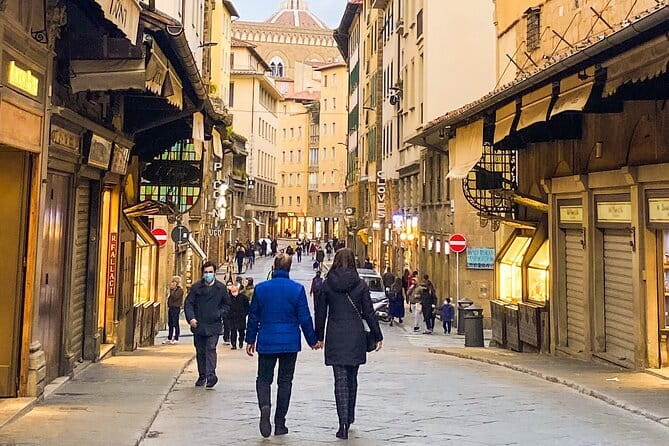
- Ponte Vecchio from the walking lane, with meaning behind the jewelry shops
A 2-hour route that teaches you how Florence is organized
Florence can feel like a puzzle at first. Streets twist, bridges funnel you one direction, and you keep seeing the same landmarks from new angles. This private walk helps you build a mental map quickly, because the sights come in a logical order: a Roman-era starting point, the spiritual heart around the Duomo, then the political center at Piazza della Signoria, and finally the iconic bridge over the Arno.
You will cover a lot of ground without it feeling like a sprint. And because it is private, you can ask the odd question that always comes up in Florence, like why a building is shaped a certain way or how a medieval term ended up in modern English. It also helps that Irina tends to use visual aids, which makes complicated details easier to hold onto while you are walking.
More walking tours in Florence:
- Florence: Guided Walking Tour
★ 4.5 · 3,334 reviews - Skip the line: Uffizi and Accademia Small Group Walking Tour
★ 4.5 · 3,135 reviews - Florence: Guided Walking Tour
★ 4.6 · 1,602 reviews
Piazza della Repubblica: Roman Florentia, plus the funny local nickname
You start at Piazza della Repubblica, a central plaza that sits right on the historical core of Roman Florence, often referred to as Florentia. Even the way the square is discussed is part of the experience. You will hear the playful idea that this is the belly button of Florence, meaning it is a pivot point where lots of routes naturally pass through.
This stop is short, about ten minutes, so it works like a warm-up. I like it because it sets you up for what comes next. You are not staring at random facades. You are learning what the city used to be, and what the main public spaces were designed to do.
One practical note: since Piazza della Repubblica is busy, pick your meeting spot carefully and give yourself a little buffer if you are arriving late from another part of town.
Outside San Giovanni and the Gates of Paradise
From the start area, you shift toward the Baptistery of San Giovanni. You do not go inside here. Instead, you look at it from the outside and learn the stories tied to its age and importance as one of the oldest buildings in Florence.
The big talking point is the Baptistery’s famous Gates of Paradise, which are linked to Florence’s identity as a city obsessed with art and craftsmanship. Seeing the building from the street matters because Florence rewards street-level looking. You get scale, you notice details on façades, and you understand why the area became a magnet for major religious artwork over time.
If you are the type of traveler who wants to go inside every major monument, you might find yourself wishing for more indoor time. But if you want to build context first, and then decide later what to enter, this outside-focused approach is a smart way to prevent impulse tickets you might regret.
Santa Maria del Fiore (Duomo) and Brunelleschi’s dome, understood in plain terms
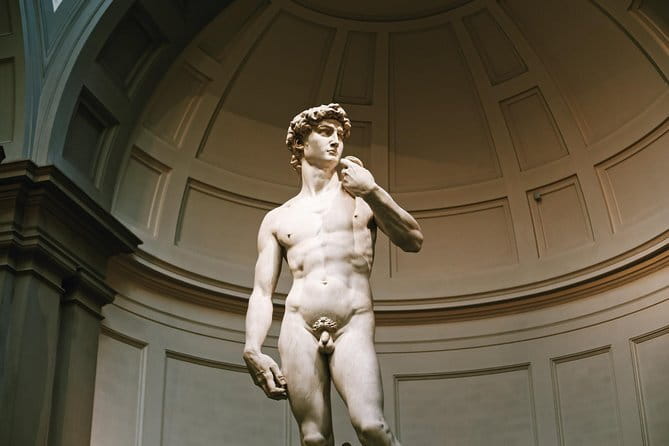
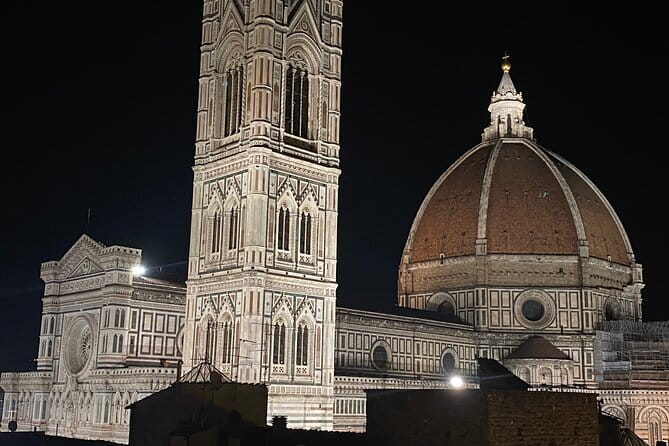
Next comes the Duomo area, built around Santa Maria del Fiore. This is the stop where Florence usually turns from pretty into wow. You will admire the cathedral’s flower-shaped plan and, most importantly, the dome engineered by Filippo Brunelleschi.
The story you hear is not just about the dome being big. It is about why people were amazed that it could be done at all. You may also hear the idea that even Michelangelo would have found it hard to match or surpass. The point for you is not who said what. The point is that Florence produced a construction breakthrough that shaped how people thought about engineering and design.
Why this part works on a walking tour: your guide can point out how the building’s layout changes your perspective as you move. With enough time outside, you begin to see the geometry. You also start to understand why this cathedral area became the city’s public stage for centuries.
More Florence experiences worth a look
- Cinque Terre and Pisa Tower Tour from Florence Semi Private
★ 5.0 · 1,406 reviews - From Florence: Private Chianti Hills Tour with Tasting
★ 4.3 · 809 reviews - Private Self-Guided E-Bike Ride in Tuscany with Vineyard Visit
★ 5.0 · 775 reviews - Florence Private Transportation in Rickshaw
★ 5.0 · 730 reviews
Dante’s neighborhood and a church tied to his life
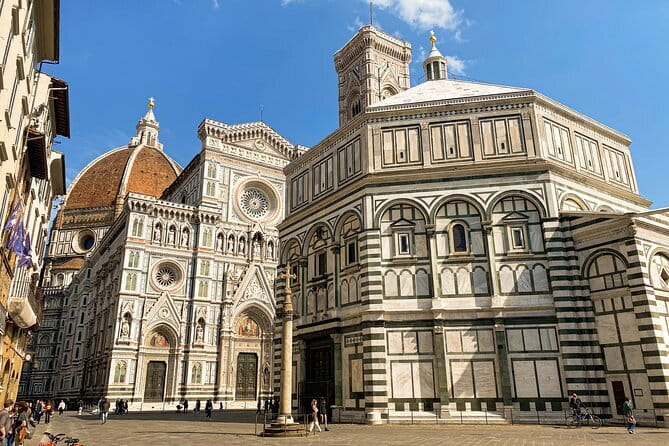
After the Duomo sights, you head into Dante’s district. This is a quieter, more story-driven segment, focused on a church connected to Dante, described as about a thousand years old in the way the tour presents it.
You will hear the angle that Dante, often called the father of the Italian language, met the love and muse of his life in a setting tied to this area. Even if you already know Dante’s name, the walk helps you anchor him to place. You are not just reading about a poet. You are connecting him to real streets where people actually lived their daily lives.
As a practical tip, this portion is easiest when you slow down mentally. Florence streets here can be crowded and you might feel pressure to keep moving. Let the guide’s pacing do the work. You get more from the stories when you are not rushing to the next photo.
Torre della Castagna and the word ballot
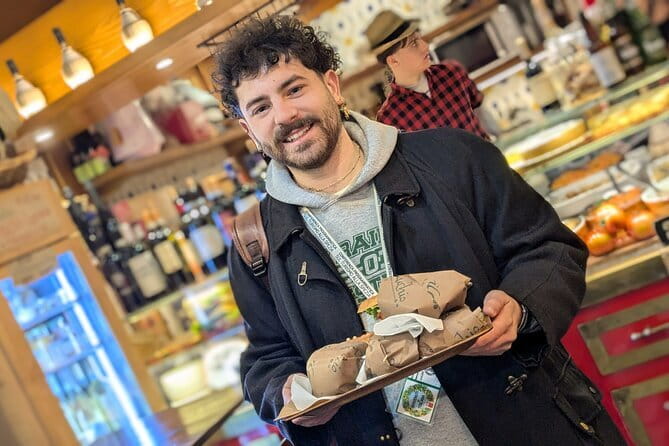
Then you reach a medieval tower called Torre della Castagna. The tour frames it as a government tower house. You also get a fun language stop: you learn where the word ballot came from.
This is the kind of detail that makes a tour worth the money. Most walking tours either rattle off dates or push you toward shops. This one gives you a small, surprising bridge between medieval civic life and modern language. It is memorable because it is weird in the best way.
A consideration: since this is a short segment, you will not walk away with a full literature lesson. But you will leave with at least one clear takeaway you can later explain to friends back home.
Piazza della Signoria: the open-air museum square
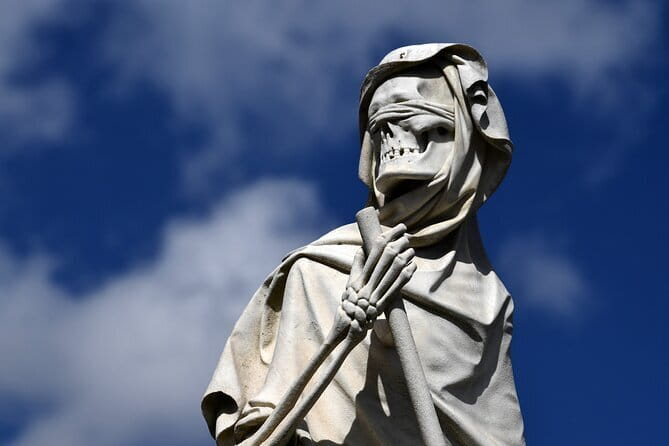
After that, the walk lands at Piazza della Signoria, which the tour presents as Florence’s political center. The square works like an outdoor museum because it gathers original sculptures created by Renaissance artists and displays them in a public space.
You will spend about twenty minutes here, and that is a good chunk of time. It is long enough to notice that the sculptures are not just decorative. They are statements, placed in a square where politics, power, and public life meet.
If you like people-watching, this is also where you naturally slow down. The square can be busy, but it has a kind of historic gravity. You might also find yourself talking back to your guide, which is exactly what you want to do on a private tour.
Palazzo Vecchio and the idea of power plus punishment
In the Piazza della Signoria area, you also look at Palazzo Vecchio, described as a medieval fortress. The big themes here are the Medici connection and the prison for dangerous criminals.
This matters for understanding Florence’s evolution. Palazzo Vecchio is not just a pretty building. It represents how power worked, how decisions were made, and how society managed threat and control.
Because this stop is a look from the square, you are not getting a museum ticket in this moment. That can be a drawback if you planned to spend lots of time inside. But as a value trade, it keeps the schedule moving so you still reach the bridge and end your walk on a high note.
Ponte Vecchio at the end: jewelry rows, Arno views, and real context
Your walk ends at Ponte Vecchio, Florence’s symbol and the oldest bridge in town, famous for its jewelers’ shops hanging over the Arno river.
This is a perfect ending point because Ponte Vecchio always looks best when you approach it with the stories already in your head. After hearing about politics at Signoria, you understand more about why Florence cared about controlling key crossings. After hearing about craftsmanship around the cathedral area, the jewelry focus on the bridge becomes more than a tourist photo.
You will get time to simply take it in and to connect the dots. And because it is the end of the walk, you can decide on the fly what to do next, like where to grab a coffee or which direction to head for dinner.
Why this feels better than a standard group walk
Private tours are not automatically better. But this one has specific advantages that show up in the way Irina leads.
First, she tends to answer questions in real time. If you stop walking to ask why a detail matters, the guide does not just move you along. That is huge in Florence, where confusion is normal and good questions are part of the fun.
Second, the pace feels relaxed. You get enough time at major viewpoints to actually look, not just point and march. In a city where crowds can push you around, this pacing helps you feel in control.
Third, there is flexibility. If you have limited time that day or you want to adjust the flow slightly, a private guide can often meet you where you are. That is a real quality-of-life upgrade.
Price and value: what $150.37 buys you in Florence
At $150.37 per person for about two hours, this is not a budget deal. But you are buying a few things that add up fast in Florence.
You are paying for private guiding, in English, with your group only. You are also paying for a route that strings together Roman roots, religious landmarks, and civic power sites so you leave with more than a stack of photos.
Another value angle: certain stops are described as free from an admission ticket standpoint, which fits the outside-view style of the tour. That means your money is focused on interpretation, not entry fees.
If you are traveling as a small group, look at the group discount option. Sharing the cost can make this feel much more reasonable, especially compared with booking multiple separate tours or paying for individual guide time that does not connect the sights into a coherent story.
Scheduling it smart: picking a departure time and keeping your day easy
You can choose from several departure times to fit your schedule. That matters because Florence is different at different hours. Morning often feels calmer for walking, and late afternoon can shift crowds around the most popular squares.
Pick a time that gives you recovery afterward. The tour is two hours, but you are walking through central Florence, then you still need energy for whatever you plan next, whether that is the Uffizi area, a gelato crawl, or simply wandering toward sunset.
Also, plan your footwear like you mean it. Even if the pace is relaxed, you will be on streets and uneven stone. Good shoes are the difference between feeling proud of your day and counting minutes until you sit down.
How to get the most out of your guide in Florence
Here is what you can do to turn the tour into real learning, not just sightseeing.
1) Ask at least one question about each main stop
When you reach the Baptistery area, ask what makes it important. When you reach the Duomo, ask how Brunelleschi’s dome changed what was possible. With this format, you get a clear answer while you still see the thing.
2) Use the streets for your notes
As you walk, pay attention to how buildings relate to the square. Florence is all about sight lines. The guide will point things out, but you can also notice details on your own.
3) Save one decision for after the walk
Because the tour keeps things outside-focused, you can decide later what you want to enter. That is often better than booking too much in advance.
Should you book this private Florence walking tour?
Yes, if you want a high-quality introduction to Florence’s most important areas and you like stories that connect buildings to everyday power, art, and language. It also fits well if you prefer a calm pace and you want to talk things through with a guide rather than follow a fixed script.
No, if your priority is spending lots of time inside major sites or if you already know Florence well and only need specific answers. This tour is built to get your bearings fast and to give you context you can carry into the rest of your trip.
If you are deciding between skipping guided time and doing your own self-guided walk, I would lean toward booking this, especially with Irina’s approach and the strong satisfaction score. Two hours is enough time to start understanding Florence, not just passing through it.
FAQ
How long is the private walking tour?
It lasts about 2 hours.
Where does the tour start and end?
It starts at Piazza della Repubblica, 50123 Firenze FI, Italy and ends at Ponte Vecchio, 50125 Firenze FI, Italy.
What is the price per person?
The price is $150.37 per person.
Is the tour private?
Yes. It is a private tour or activity, and only your group will participate.
What language is the tour offered in?
The tour is offered in English.
Which major sights are included in the walk?
You will see Piazza della Repubblica, the Baptistery of San Giovanni area from the outside, Santa Maria del Fiore (Duomo) from the outside, Dante’s district with a church tied to him, Torre della Castagna, Piazza della Signoria, Palazzo Vecchio, and Ponte Vecchio.
Do I need an admission ticket for these stops?
The tour description lists free admission tickets for the listed stops, and the sights are presented for viewing during the walk. (No inside-entrance details are provided.)
Is it easy to join if I use public transportation?
The meeting area is near public transportation.
What is the cancellation policy?
You can cancel for free up to 24 hours in advance of the experience start time for a full refund. If you cancel less than 24 hours before, the amount paid is not refunded.
Just reviewed around Florence
- Art and History in Florence: Small Group Walking Tour★ 5.0 · 25 reviews
- Sculpture in Florence : Traditional Clay modelling class★ 5.0 · 12 reviews
- Exclusive Cinque Terre Day Trip from Florence★ 5.0 · 102 reviews
- Florence treasures on a city bike – 1 day rental –★ 5.0 · 25 reviews
- Private Tour to Cinque Terre in English, Español and Purtuguês★ 5.0 · 3 reviews
- Full-Day Small-Group Cinque Terre Tour from Florence★ 4.5 · 58 reviews
- Cinque Terre Vibes with Postcard Perfection and Lunch Treats★ 5.0 · 3 reviews
- Cinque Terre Private with the leaning tower Pisa from Florence★ 5.0 · 9 reviews
Walking Tours, compared.
Skip the line: Uffizi and Accademia Small Group Walking Tour
Read our review →
Renaissance and Medici Tales Guided Walking Tour
Read our review →
Skip-the-Line Florence Highlights and David Walking Tour
Read our review →
Browse the lists this tour appears in