
Reviewed · WALKING TOURS
The Best of Florence Walking Tour in a Small Group
This small-group walking tour is interesting because it turns Florence’s big-name landmarks into a clear story about power, art, and daily life, all on foot over about 1 hour 45 minutes. The group cap of 15 and whisper audio system help you stay together and actually hear the guide, even in peak crowds.
I love how the route moves from Medici foundations, to the cathedral complex, and then into the political heart of town. Guides like Manuel and Camilla are praised for making the history feel practical, with recommendations for what to do next and where to eat along the way.
One possible drawback: admission tickets are not included for many of the stops, so you’ll want to decide ahead of time what you want to see up close versus what you’re happy to view from the street.
Key things that make this tour worth your time
- A Medici-to-Duomo route that explains the “why,” not just the “what” as Florence shifts from banking power to sacred space.
- Michelangelo’s fingerprints show up fast across the Laurentian Library and the Medici Chapels area.
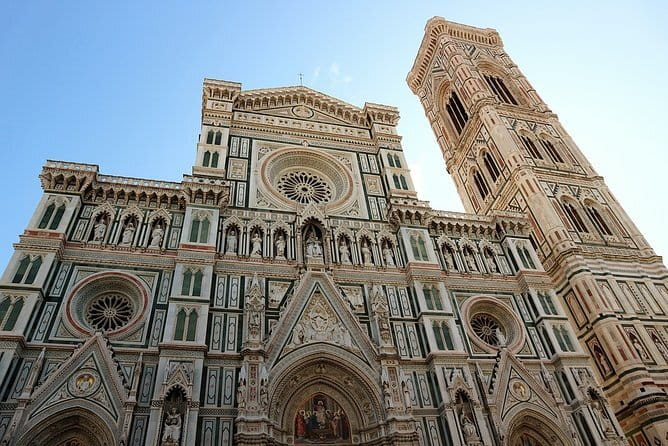
- A structured walk through the Duomo complex zone so you understand how the cathedral, baptistery, Giotto tower, and Brunelleschi dome fit together.
- Small group energy with a maximum of 15 people, so you can ask questions and keep a steady pace.
- Whisper system audio so you can hear without craning your neck or playing guess-the-words.
- An ending that lands you where the photos and wandering start near Ponte Vecchio and the Arno.
Why this Medici-and-Duomo walk is the smartest first-day plan
If it’s your first time in Florence, the city can feel like a nonstop quiz: you see the famous marble everywhere, but you may not know what you’re looking at or why it matters. This tour solves that problem in a very walkable way, starting in the Medici orbit and then guiding you straight through the Duomo neighborhood and the main civic square.
The value is not only that you hit the top sights. It’s that the guide gives you a framework. You walk away understanding how Florence’s ruling families used churches, libraries, and architecture to project status, and how that same power shows up in the public spaces where people gathered.
It’s also built for sanity. The pacing is designed for a 1 hour 45 minutes experience, and the group stays small. That means less time getting stuck behind strangers and more time learning what to notice when you return on your own.
More walking tours in Florence:
- Florence: Guided Walking Tour
★ 4.5 · 3,334 reviews - Skip the line: Uffizi and Accademia Small Group Walking Tour
★ 4.5 · 3,135 reviews - Florence: Guided Walking Tour
★ 4.6 · 1,602 reviews
Meeting in the San Giovanni area, and what the timing feels like
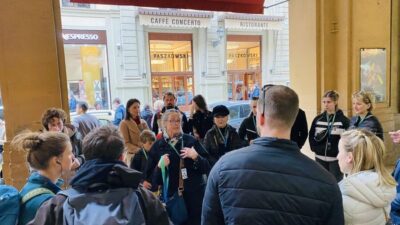
You meet at Caffè Scudieri Firenze in Piazza di San Giovanni 19R. The start time is 12:15 pm, and the tour ends near Ponte Vecchio (the exact end point can vary slightly in the indicated area).
That midday start can be a plus. You’ll get traction on the center of town before your evening plans, and you’ll end near a major pedestrian draw so you can keep wandering right after. It also lines up well if you want to pair this with an afternoon museum visit, or with a slower dinner nearby.
Bring comfortable shoes. This is a walking tour through historic streets, and even when stops are short, you’re moving. Also, expect crowds around the Duomo and the main squares. The good news is you’ll be moving as a group with a guide who helps you keep your bearings quickly.
Basilica di San Lorenzo: where Florentine power became sacred
The walk begins at Basilica di San Lorenzo, one of Florence’s largest churches. This stop is not just about grand architecture. It’s about identity. The basilica sits in the main market district and functions as a burial place for key Medici family members, from Cosimo il Vecchio through Cosimo III.
For me, this is where the Medici story becomes real. You can see how a ruling family wanted to connect money, influence, and spiritual legitimacy. The guide helps you connect the dots so you’re not just looking at a famous church, you’re understanding why it was chosen for this role.
A practical note: the stop is brief, and admission ticket is not included. So treat it as an orientation stop. If you want to go deeper inside on your own, you’ll be better prepared to know what to look for.
Biblioteca Medicea Laurenziana: Michelangelo-designed drama in a library
From the church world, you shift into a place that’s almost the opposite of a museum: the Laurentian Library. This is tied to the Medici pope, Clement VII, and it was designed to signal that the Medici were no longer seen only as merchants. The message was status, intellectual authority, and ecclesiastical legitimacy.
What makes this stop especially memorable is the guide pointing out the architectural work associated with Michelangelo and how it reflects Mannerism. Even if you only see parts quickly, it helps you understand that Florentine art is not confined to paintings and statues. It lives in spaces built to shape how people think.
Again, the interior access is not included (admission ticket not included). The upside is that you’re not left staring at a door for too long. The guide keeps the stop efficient, so you can move on while the story stays fresh.
A different way to spend the day in Florence:
- Florence: Skip-The-Line Uffizi Gallery Timed Entry Ticket
★ 4.5 · 27,832 reviews - Tuscany Day Trip from Florence: Siena, San Gimignano, Pisa and Lunch at a Winery
★ 5.0 · 21,634 reviews - Florence: Timed Entrance Ticket to Michelangelo’s David
★ 4.6 · 16,983 reviews - Florence: Michelangelo’s David Skip-the-Line Entry Ticket
★ 4.5 · 12,764 reviews
Medici Chapels and the Sagrestia Nuova: the art is the message
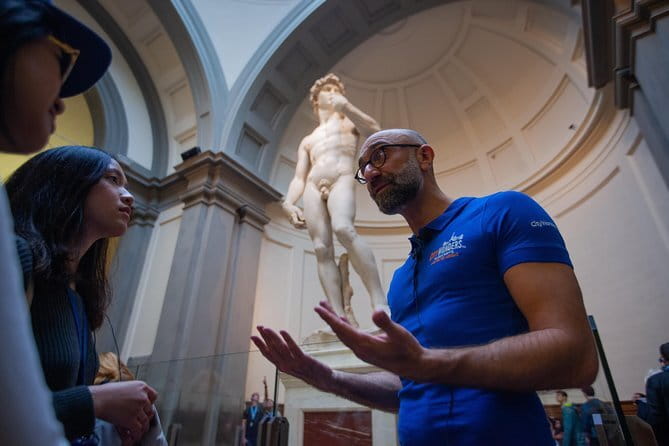
Next come the Cappelle Medicee, built between the 16th and 17th centuries as extensions connected to Brunelleschi’s earlier church. Here, the purpose is explicit: the chapels celebrate the Medici family and the Grand Dukes of Tuscany.
One standout in this zone is the Sagrestia Nuova, the New Sacristy. It is associated with Michelangelo, and it’s the kind of place where the guide’s framing really matters. If you’re going in with no context, you can miss why the design feels so intentional. With context, you start noticing the choices, the symbolism, and the way the space pushes emotion.
As with other major interiors on the route, admission ticket is not included, and the stop is time-limited. That’s not a deal-breaker, though. It’s a smart preview that helps you decide whether you want to pay to see more later.
Palazzo Medici Riccardi: banking turned into architecture
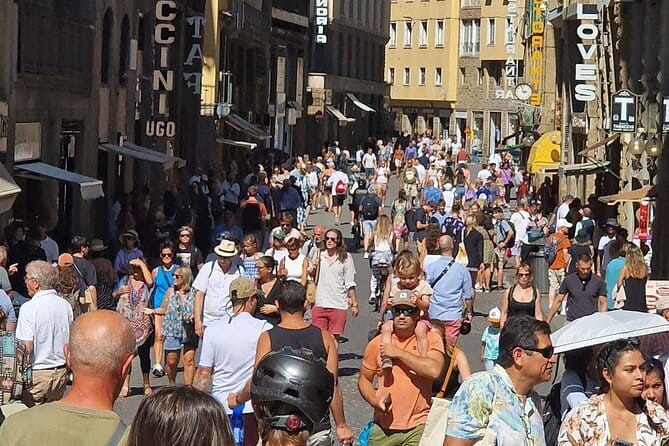
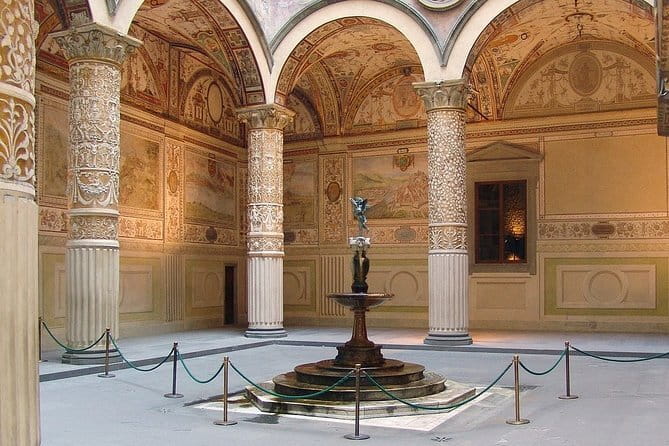
The walk then pauses at Palazzo Medici Riccardi, designed for Cosimo de’ Medici. Construction ran from 1444 to 1484, which tells you something important. This was not a quick decoration project. It was a long-term statement.
What I like about this stop is that it reframes Renaissance Florence. Yes, you’ll see churches and domes. But you also learn how power was built through money, offices, and residences. The Medici didn’t just fund art. They built environments that made their influence feel permanent.
This is another short stop with admission ticket not included. So, treat it as an exterior-and-context moment. The guide makes the palace feel connected to everything you’ll see later, especially once you reach the Duomo area and Piazza della Signoria.
Duomo complex, baptistery, Giotto tower, and Brunelleschi dome
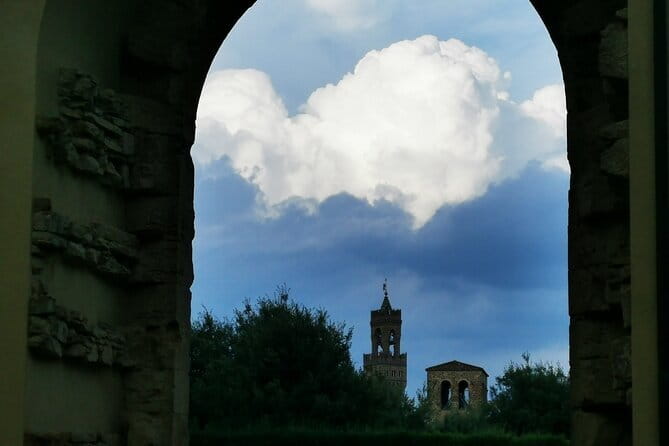
The heart of the route is the cathedral zone. You get a guided loop through Piazza del Duomo, the cathedral complex that includes the Baptistery and Giotto’s Campanile, all part of Florence’s UNESCO historic center.
Santa Maria del Fiore: the cathedral façade lesson
At Cattedrale di Santa Maria del Fiore, or the Duomo, the guide helps you connect the Gothic beginnings (begun in 1296) to the broader identity of the cathedral complex. The cathedral sits at a crossroads of design eras, and once you understand that, you stop seeing it as one big “pretty building” and start seeing it as a timeline in marble.
This stop is listed with admission ticket free in the tour details. You’re not paying to stand near it and understand what you’re seeing, which is a good match for a group walking tour.
Baptistery of San Giovanni: Romanesque roots and a street-facing landmark
Across the plaza, you look at the Battistero di San Giovanni, built between 1059 and 1128 in the Florentine Romanesque style. This is one of those sights that makes you realize Florence has layers. Even when the Duomo looks like the star, the baptistery shows older DNA.
The stop lists admission ticket not included, so it’s best used as a guided look and orientation. The guide helps you notice placement and what the baptistery means in the cathedral complex story.
Campanile di Giotto: Gothic showpiece made to be seen
Adjacent to the cathedral and baptistery is Giotto’s Campanile. The guide points out the rich sculptural decorations and polychrome marble encrustations, and helps you understand why this tower feels like Florence in a nutshell: dramatic, detailed, and meant to be read from afar.
The stop lists admission ticket not included. Even so, you’ll get the big visual cues and the “what to notice” prompts you can use later if you return.
Brunelleschi’s Cupola: the brick-dome mystery from street level
Then you get to the dome, Cupola del Brunelleschi. The tour highlights it as one of the largest brick domes ever constructed and something that has long inspired questions around how it was achieved.
Even if you’re not going inside (tickets are listed as not included), this is a great place for the guide to slow your thinking. The dome is so famous that people forget to look at what it means structurally and visually. The stop is longer than most, which makes sense.
You also circle the cathedral area again, which helps it stick. By the time you leave this zone, you should be able to point out which building is the baptistery, which is the tower, and where the dome sits in the bigger puzzle.
Piazza della Signoria and Palazzo Vecchio: where Florence staged politics
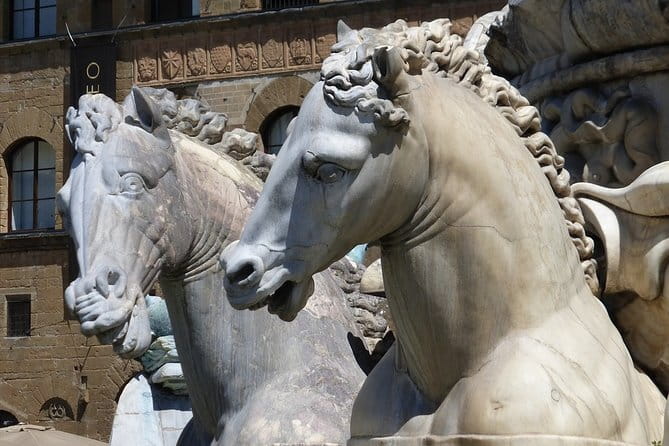
Once you leave the Duomo zone, the tour moves to Piazza della Signoria, an L-shaped square in front of Palazzo Vecchio. This is where Florence gathers, and it’s also where history gets acted out in stone.
This stop is listed as admission ticket free, so you can focus on atmosphere. The guide helps you see how the square works as a gateway to other sights, including the nearby Uffizi area.
Then comes Palazzo Vecchio, the city hall, described as a massive fortress-palace. From here you also get a view toward the square’s famous statue copy of Michelangelo’s David and the Loggia dei Lanzi nearby.
This is another quick stop with admission ticket not included, which is fine. The point is to understand the role of the building, not to spend your whole afternoon touring it. If town hall energy is your thing, you’ll know where to aim later.
Uffizi Gallery from the outside: why offices became a museum
Near Piazza della Signoria, you pass by the Gallerie degli Uffizi. The tour explains that the Uffizi complex began under Giorgio Vasari in 1560 for the Medici, to house the offices of Florentine magistrates. That’s where the name comes from, tied to offices.
This detail matters. It stops you from thinking of the Uffizi only as a museum you queue for. It becomes part of the civic story of who ran Florence and how spaces were designed for power.
The stop lists admission ticket not included, so you’re not doing a museum visit here. But you are setting yourself up. If you’re planning to buy tickets to the Uffizi later, this guided “origin story” helps the art context click faster.
Ponte Vecchio and Palazzo Pitti: the ending that keeps pulling you forward
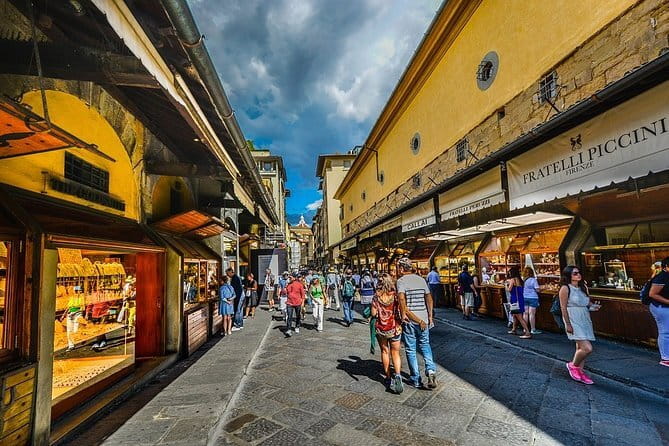
The tour heads toward Ponte Vecchio, the oldest bridge over the Arno in Florence. The big feature here is the shops built along it. Historically, butchers, tanners, and farmers occupied these spaces. Today, the tenants are mainly jewelers and art dealers, which keeps the bridge feeling like a place where commerce and culture overlap.
This stop lists admission ticket free, which is perfect. You can enjoy the atmosphere without extra entry fees.
Finally, you pass Palazzo Pitti, which the Medici family bought in 1549 and made their main residence for the ruling families of Tuscany. Over time it grew into a kind of treasure house, collecting paintings, plates, jewelry, and luxury possessions.
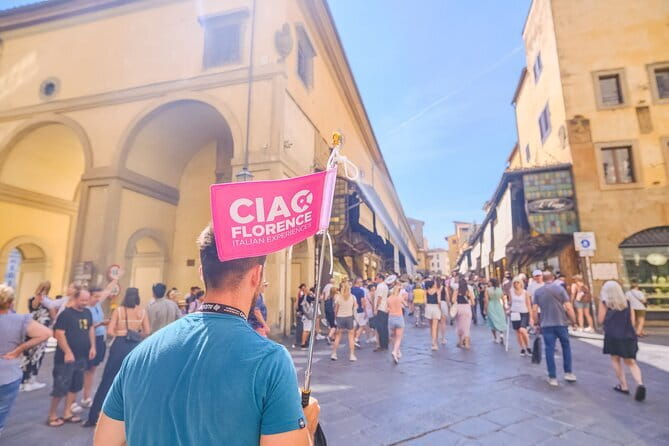
The tour ends near Ponte Vecchio, which is a smart finishing move. You’re dropped into an area where you can keep wandering on your own, or simply take a break and process what you learned. If you still have energy, you’ll know what to look for next because the Medici thread is still in your head.
Price, tickets, and whether the 59 dollars feels fair
At $59.26 per person, this tour is priced like a short guided city walk. Is it a bargain? Often, yes, because you’re getting a licensed guide and the group stays capped at 15. In a city where you can easily burn an afternoon without a plan, that kind of structure is worth real money.
The catch is tickets. The tour details say admission ticket not included for many major sites, including the Medici church and chapel areas, the library, and multiple stops in the cathedral zone. Only a few stops are explicitly listed as free in the tour information, like the Duomo stop, Piazza della Signoria, and Ponte Vecchio.
So here’s how I’d think about value. If you want a guided orientation plus context, this tour makes sense at this price. If you’re hoping to access everything indoors on the ticket alone, you’ll need to plan extra entries elsewhere.
Who should book this walking tour, and who might skip
This is a great pick if:
- You want a first-day Florence intro that doesn’t take you all day.
- You like learning the story behind famous buildings, not just taking photos.
- You prefer a small group experience where hearing the guide matters, thanks to the whisper system.
- You enjoy architecture and Renaissance politics, especially the Medici angle.
It might be less ideal if:
- You only care about one or two interiors and hate paying separate admission fees.
- You need long seated museum time, because this is a walking format with short stops.
It’s also described as suitable for most travelers, with service animals allowed, and it runs near public transportation. Still, wear shoes that can handle cobblestones and keep moving.
Practical tips so the day runs smoothly
Start with the right expectations. This tour is about seeing and understanding. It is not a full museum day.
Wear comfort first. The stops are brief, and the route is dense with famous sites. A hat or sunglasses help too, since the center can get sun-heavy. If shade matters to you, guides have been praised for adjusting where they pause when possible.
If you’re traveling with kids, look for guides who keep the story lively. In the past, guides like Manuel have been praised for tailoring attention to keep children engaged. That doesn’t guarantee anything, but it’s a good sign you’ll likely get an animated approach.
Finally, treat the food and shopping tips as optional bonus material. The guide often shares recommendations for what to do next and where to dine, and those suggestions can save you time later when you just want to eat without overthinking.
Should you book this tour?
Book it if you want a guided, small-group walk that ties together the Medici story, the Duomo complex, and Florence’s civic core, without turning your day into a ticket-and-line marathon. At about 1 hour 45 minutes, it’s one of the most efficient ways to get your bearings and learn what you’re seeing as you go.
Skip it if you’re already comfortable with Florence’s political-art connections and you mostly want deep interior access. In that case, you might do better using your time on standalone museum tickets and a self-guided plan.
If you do book it, you’ll finish the walk with a clearer mental map, smarter priorities for the next day, and an easier time enjoying the streets instead of just rushing past them.
FAQ
How long is the Florence walking tour?
It runs for about 1 hour 45 minutes.
How many people are in the group?
The group size is capped at a maximum of 15 travelers.
What languages is the tour offered in?
The tour is offered in English.
Are entrance tickets included?
Most stops list admission ticket not included. One stop (the Duomo, Cattedrale di Santa Maria del Fiore) is listed as ticket free, and Piazza della Signoria and Ponte Vecchio are also listed as ticket free. Tips and gratuities are not included.
Where do I meet, and where does it end?
You meet at Caffè Scudieri Firenze, Piazza di San Giovanni 19R, 50123 Firenze FI, Italy. The tour ends near Ponte Vecchio, 50125 Firenze FI, Italy.
Does it include audio so I can hear the guide?
Yes. It includes a whisper system.
Can I get a refund if I cancel?
Yes, you can cancel for a full refund up to 24 hours in advance of the experience start time. If you cancel less than 24 hours before, the amount you paid is not refunded. The cut-off times are based on local time.
Just reviewed around Florence
- Tuscany: Leonardo da Vinci – Oil and Wine Discovery Tour★ 4.8 · 5 reviews
- Livorno Port, Pisa, Florence: Full-Day Shore Excursion★ 4.8 · 51 reviews
- Legends of Florence: Exclusive Walking Tour by night★ 4.9 · 70 reviews
- Leather and Passion: A Tour of Florentine Craftsmanship★ 5.0 · 16 reviews
- Illuminated Florence Tour for Kids with Gelato & Pizza★ 5.0 · 6 reviews
- Inferno Florence Private 3-Hour Tour★ 4.8 · 20 reviews
- Hidden Florence: 2-Hour Guided Walking Tour★ 4.7 · 36 reviews
- 3-Hour Historic WhoDunIt Tour in Florence★ 3.2 · 6 reviews
Walking Tours, compared.
Skip the line: Uffizi and Accademia Small Group Walking Tour
Read our review →
Renaissance and Medici Tales Guided Walking Tour
Read our review →
Skip-the-Line Florence Highlights and David Walking Tour
Read our review →
Browse the lists this tour appears in