
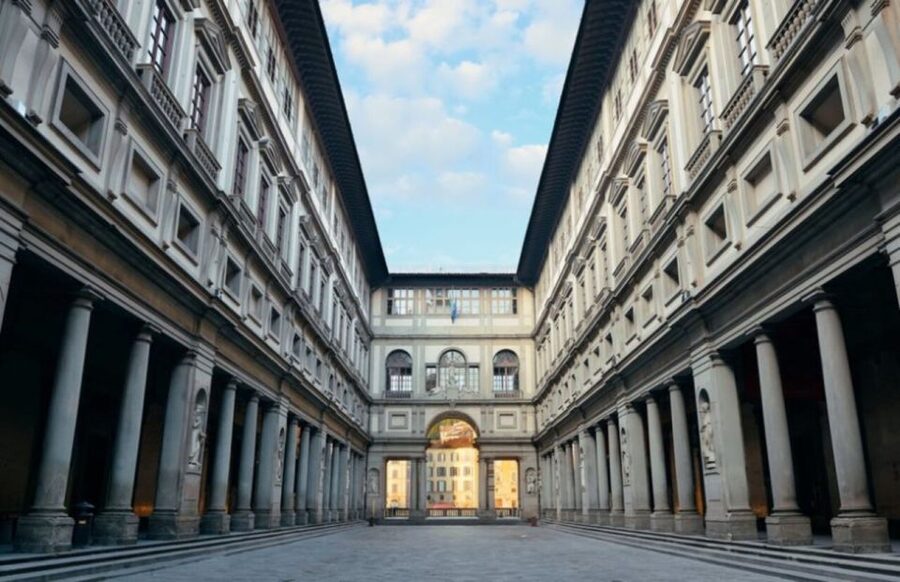
Reviewed · WALKING TOURS
Florence: Walking Tour of Dante’s Florence with a Guide
A walking tour that reads Florence like a page from Dante makes this city feel sharply personal. I like how it ties major landmarks, Duomo Square, and the city’s medieval layout directly to Dante’s life, and I love that you’ll walk through the ideas behind the Divine Comedy using real streets and buildings. One possible drawback: with a tight 2-hour route, you will move at a good pace, so come prepared for quick photo stops.
What helps most is the human touch. A live guide in English or Italian brings the details into focus, and people also mention guides like Oksana for making Dante feel vivid, not dusty. You should also plan for some walking on uneven old-stone streets, even though the tour is listed as wheelchair accessible.
Key things to know before you go
- Duomo Square starts the story with San Giovanni and the medieval entrance into the part of town tied to Dante.
- You’ll look up for Dante’s name on ancient tower walls, which changes how you experience the skyline.
- Two life-moment stops matter: the place thought to be Dante’s birth area and the spot associated with his first sight of Beatrice.
- Ponte Vecchio is used for a legend about the Guelphs and Ghibellines and how Florence divided.
- Palazzo Vecchio enters the Dante timeline because Dante’s funerary mask is kept inside.
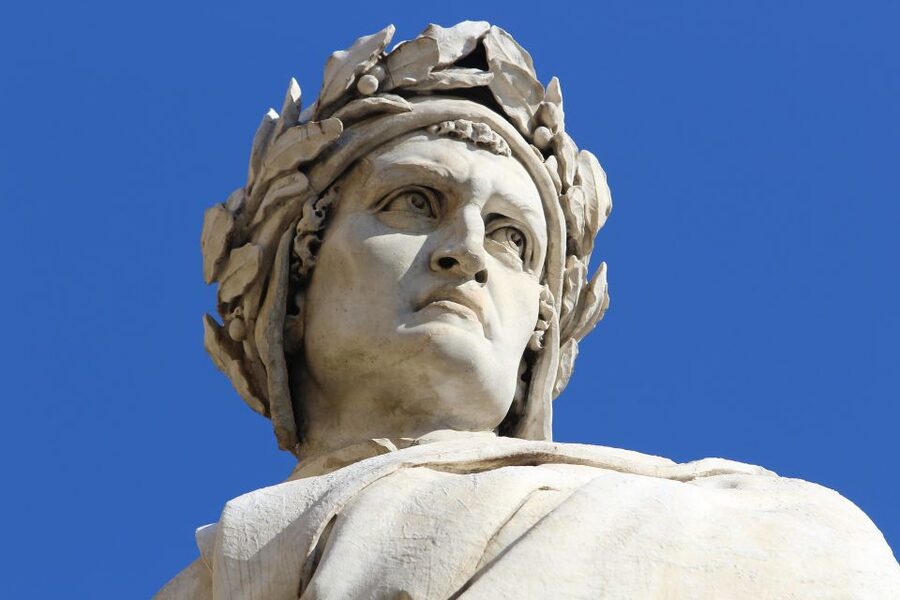
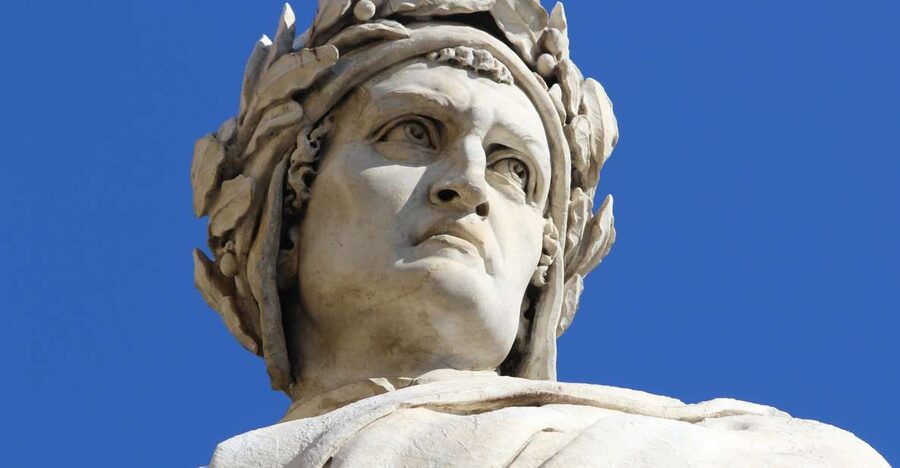
- The tour closes with a strong visual at Piazza Santa Croce with a marble Dante statue holding the Divine Comedy.
Why Dante’s Florence feels different than a standard sightseeing walk
Most Florence walks give you a greatest-hits list. This one gives you a storyline. You’re not just moving from famous stop to famous stop, you’re following Dante Alighieri’s Florence from birth to exile, roughly 1265 to 1302, and then connecting it to the literary world behind the Divine Comedy.
The practical magic is that the guide keeps pointing out what has changed and what has not. Florence in Dante’s time was a maze of narrow streets, stone-built houses, wooden houses, towers, small churches, and work spaces. That city type is hard to picture when you arrive modern-day, with big views and polished stone. Here, you get help turning streets and facades into an idea of how the poet would have experienced the city, moment by moment.
Also, this tour is built around theme. You’ll literally walk through steps tied to the Divine Comedy and not just recite poems. That makes the stops feel purposeful, especially if you know Dante’s name but have not mapped his story onto Florence before.
More walking tours in Florence:
- Florence: Guided Walking Tour
★ 4.5 · 3,334 reviews - Skip the line: Uffizi and Accademia Small Group Walking Tour
★ 4.5 · 3,135 reviews - Florence: Guided Walking Tour
★ 4.6 · 1,602 reviews
Starting at Loggia Bigallo Museum and orienting at Duomo Square
You meet in front of the Loggia Bigallo Museum. From there, the route’s first big anchor is Duomo Square, where you’ll begin your medieval Florence orientation.
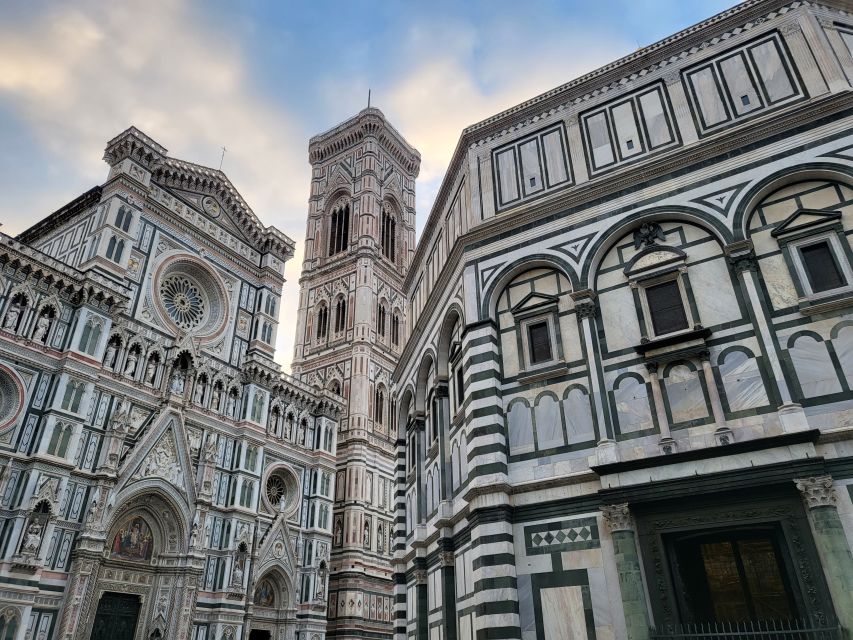
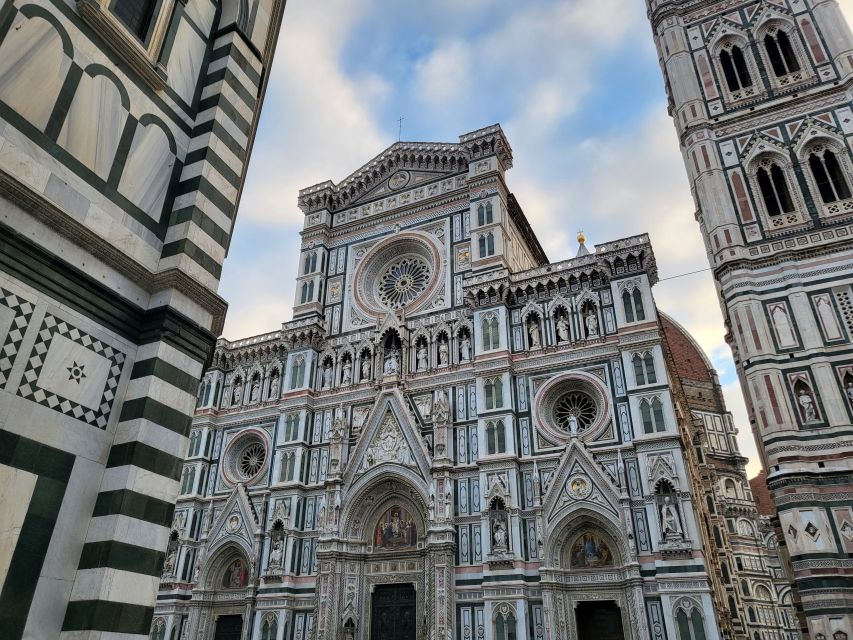
Duomo Square matters because it was an entrance area in medieval times. The guide frames it that way so you can stop seeing the square as a selfie platform and start seeing it as a threshold. The key building here is the Baptistery of San Giovanni, listed as standing in the square, and the oldest building of the city is part of the opening picture.
This is also where you start hearing the Dante-specific logic of the walk. The tour introduces something you might not notice on your own: looking upward in Florence reveals carved words connected to Dante on ancient tower walls. That single cue changes the whole experience. After that, you start noticing details you would otherwise miss, like how tower facades functioned as visual markers in the medieval city.
If you want the most out of the opening, arrive on time and keep your phone charged. Early orientation matters because the route later depends on understanding why places are grouped the way they are.
Looking up for Dante on tower walls, then the birth and Beatrice moments
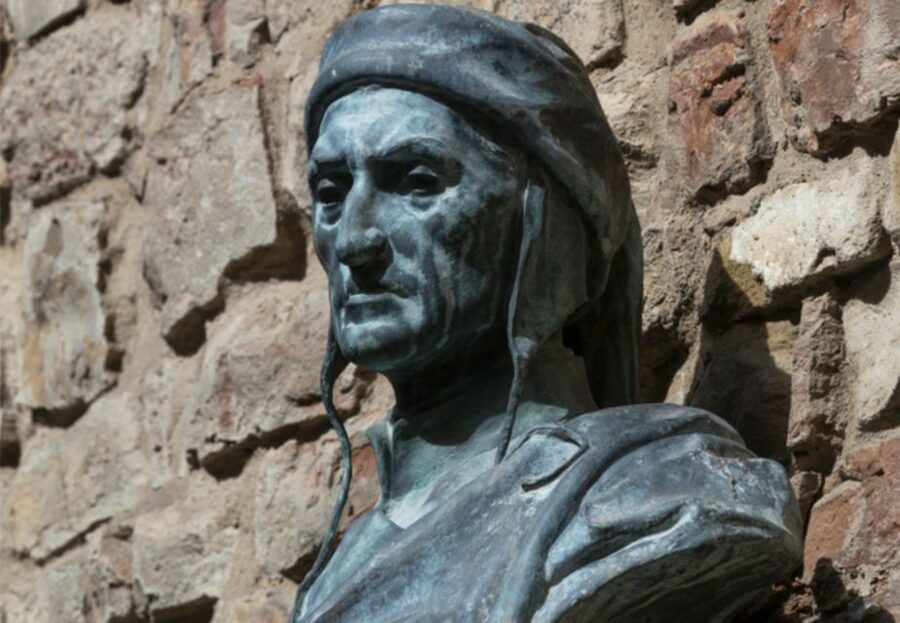
Once you’re set in place at Duomo Square, the tour moves from monuments to narrative. You’ll investigate through monuments, tombstones, characters, houses, towers, and historical streets that connect to Dante’s life.
Two of the most emotional stops are tied to origins. The tour includes the place thought to be where Dante was born and the place where he is thought to have first seen Beatrice. Even if these locations are debated historically, the guide’s job is to show how the Florence of Dante’s time gives meaning to these stories, and how later tradition attached them to physical corners of the city.
This is where the tour’s medieval tone comes through. Florence called itself Fiorenza in Dante’s era, and many of the city’s most famous architectural features you might associate with modern Florence were not built during Dante’s lifetime. The route helps you feel that gap, like walking inside a city that is less complete but more alive, full of small structures and human-scale movement.
Practical note: this is not a sit-down museum tour. You’ll walk, listen, and glance around frequently. Bring a light layer if you’re going in cool weather, and keep your attention on the guide when you’re looking up. Tower inscriptions are the kind of detail that slip away if you’re multitasking.
Dante Studies Center and Ponte Vecchio, plus the Guelph and Ghibelline legend
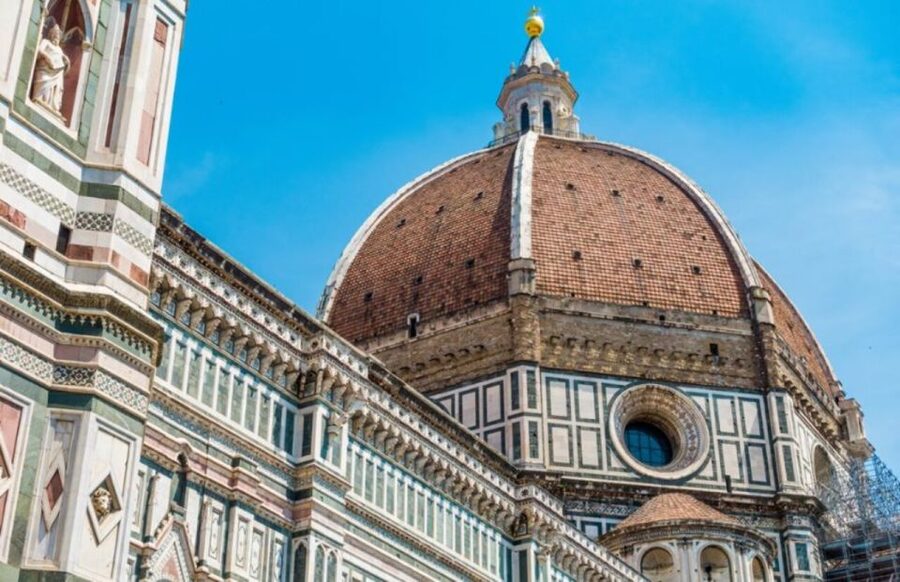
Next comes a shift from Dante’s personal story to Florence as a political and social machine. You’ll head to the Dante Studies Center and then on to Ponte Vecchio.
Ponte Vecchio is a smart choice for this theme because it is a bridge you can stand on and imagine as a dividing line. The tour uses it in a specific way: according to legend, it’s where the struggle among Guelphs and Ghibellines began, and where Florence was divided into two parts.
Whether you take the legend literally or treat it as tradition, the value here is understanding how conflict could shape daily geography. Bridges, squares, and river crossings become more than “pretty views.” They become places where a city’s identity gets split, fought over, and then remembered through stories.
At the Dante Studies Center, you get a context boost. The tour’s overall goal is to help you connect Dante’s text and imagination back to the real streets. A center stop like this works as a mental reset. It’s where a guide can organize the story so later stops, like Piazza della Signoria, make immediate sense.
When you get to Ponte Vecchio, slow down mentally even if you are walking quickly physically. Stand still for a moment and let the guide’s conflict story settle. That small pause can be the difference between hearing information and actually feeling why the place was chosen.
More Florence experiences worth a look
- The Best tour in Florence: Renaissance & Medici Tales – guided by a STORYTELLER
★ 5.0 · 12,316 reviews - Florence: Duomo Cathedral Guided Tour
★ 3.9 · 5,970 reviews - Uffizi Gallery Small Group Tour with Guide
★ 4.5 · 4,923 reviews - Florence: Accademia Gallery Guided Tour
★ 4.6 · 4,156 reviews
Piazza della Signoria and Palazzo Vecchio, where the funerary mask lives
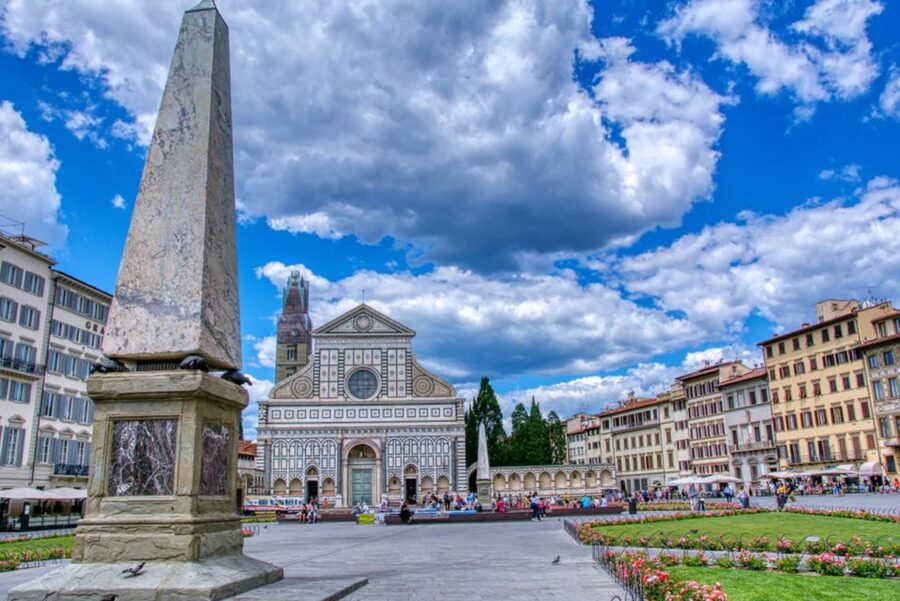
The tour then hits the political heart of medieval Florence at Piazza della Signoria, with Palazzo Vecchio as the anchor.
This section matters because it connects Dante’s personal life to civic power. It’s one thing to talk about a poet. It’s another to place him in a city where political institutions shaped who lived where, who rose, and who fell.
The key detail here is concrete: the tour points out that Dante’s funerary mask is kept inside Palazzo Vecchio. That’s the kind of stop that gives you a physical object to attach to a name you might know from a book. Even if you do not leave the palace with a new quote in your head, you leave with a stronger sense that Dante was part of the city’s public memory.
Piazza della Signoria also gives you a visual map for the whole tour. Once you’ve seen the square, you understand why earlier steps, like Duomo Square and Ponte Vecchio, were chosen as story segments. They link into this bigger idea of a medieval Florence where institutions, factions, and street life were tangled together.
Tip if you care about photography: this is a great moment to take a few quick shots straight on. Then listen first. The guide’s explanation is what makes the angles click.
Piazza Santa Croce and the Dante statue holding the Divine Comedy
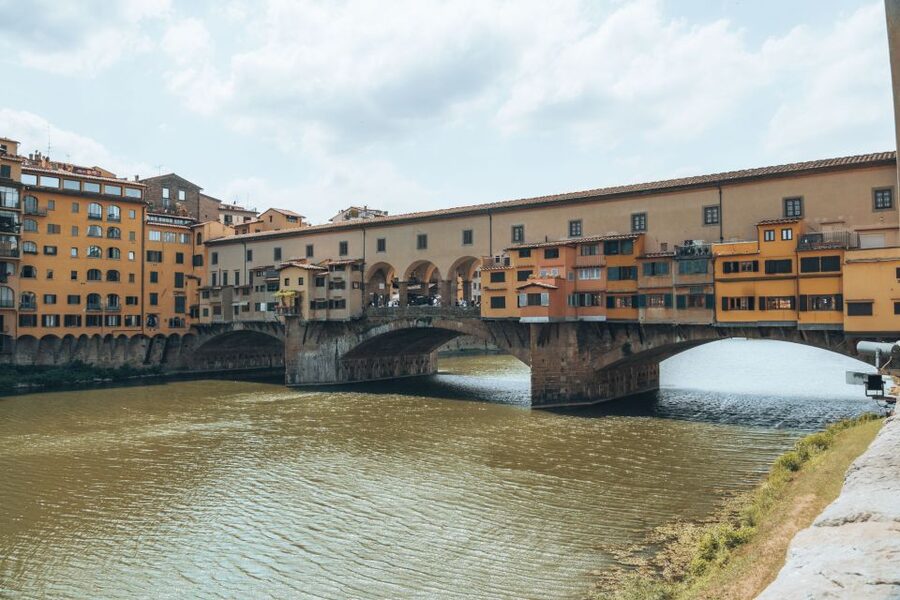
To finish, you go to Piazza Santa Croce for one of the most beautiful Dante statues on the route, where Dante holds the Divine Comedy in his right hand.
This is a satisfying ending because the tour has been building from life events to literary meaning. By the time you reach the statue, you’re not just looking at art. You’re closing a loop. The walk has tried to show you how Dante’s Florence shaped the poet’s worldview, then how those ideas connect back to the pages many people read later.
Santa Croce works well as an end location because it feels open and legible compared to the tight, tower-heavy streets you might remember from earlier stops. It gives your eyes time to reset after the more narrative-heavy corners.
If you want a helpful next step after the tour, take a moment to think about the stop you found most moving. For a lot of people, it’s the Beatrice story or the mask detail. That mental bookmark helps when you read or re-read Dante later, because you now have places tied to scenes.
Value and pace: is $34 worth it for 2 hours?
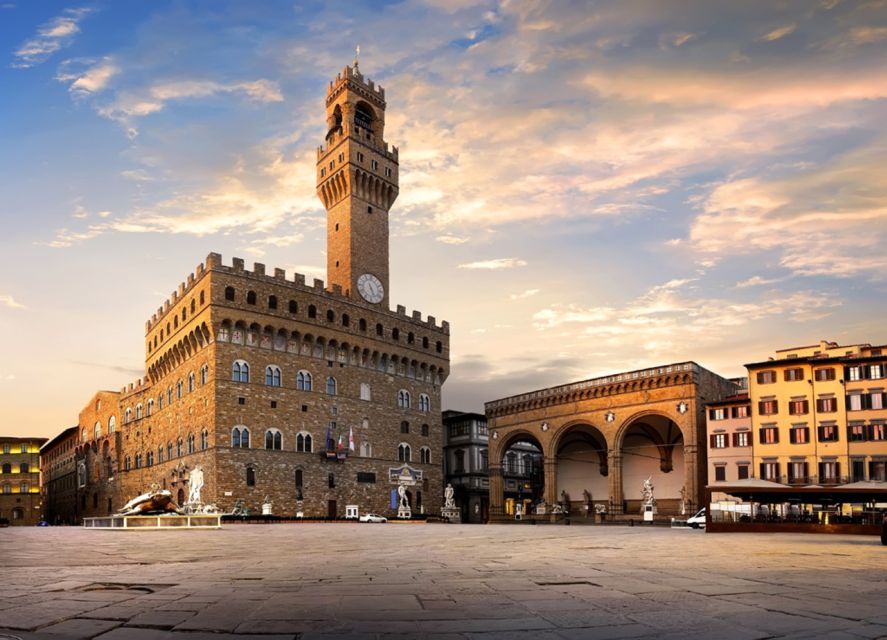
At $34 per person for a 2-hour guided walk, you’re paying for one thing most solo sightseeing trips do not provide: someone to connect the city’s physical layout to a specific story arc.
Here’s where the value comes from. You get live guiding in Italian or English, plus audio support in multiple languages. You also get a route that focuses on Dante’s timeline, including his birth period and exile years, and on a handful of high-impact stops with direct Dante connections.
If you plan to wander Florence on your own, you’ll likely hit some of these landmarks anyway. The difference is that you might not connect them into a coherent Dante-centered narrative. For many first-time visitors, that narrative is what turns Florence from overwhelming to understandable fast.
The pace is the only tradeoff to keep in mind. Two hours is enough time to cover key places, but not enough for long detours. If you’re the kind of traveler who likes to linger 20 minutes per stop, this may feel busy. If you like guided structure and short, meaningful stops, it’s a good length.
How the guide and audio support work in real life
This tour uses multiple layers of communication. You have a live guide in English or Italian. You also get an audio guide listed for English, Italian, and Spanish.
Earphones are provided only for groups over 15 participants. So if you’re traveling with a smaller group, you may rely more on the live guide’s voice. That’s another reason to show up on time and stay close enough to hear.
I also like that the tour gives enough context to make the visuals work. You’re not just being told where to stand. The guide explains why a place belongs to the Dante story and what medieval Florence looked like in daily life, not just in grand architecture.
And if you’re a fan of Dante, keep an eye out for the moments where the guide connects text concepts to street-level scenes. That’s when you start appreciating the walk as more than a route, it becomes a translation tool.
Who this Dante walking tour is best for
This works best if you fall into one of these buckets:
- You want a guided way to understand Dante’s Florence without doing heavy research.
- You love literature and want to see it anchored in streets, towers, and real civic spaces.
- You’re visiting for a short time and want strong focus in a compact 2 hours.
It’s also a great choice if you like meaningful group experiences. People mention guides who keep the mood warm and story-forward, like Oksana, and that matters because Dante can be emotional and a bit heavy. A good guide helps it feel human.
If you already know every canto and want total freedom, you might prefer a self-guided route. But for most travelers, the guided structure is the shortcut that makes the city click.
Should you book this Florence walk?
Yes, if your goal is to see Florence through the lens of Dante and medieval life, not just as a list of monuments. The route has clear anchors, Duomo Square, Ponte Vecchio, Piazza della Signoria, and Piazza Santa Croce, and it ties them into a narrative that makes the city easier to understand.
Book it especially if you want value for your time. For a $34 guided, story-focused walk, you’re buying context you would otherwise have to piece together yourself. The only reason to skip is if you hate walking fast or you need long pauses at every stop.
FAQ
Where does the tour start and end?
The tour starts in front of the Loggia Bigallo Museum. It ends back at the meeting point.
How long is the walking tour?
The tour duration is 2 hours.
What languages are available for the guide and audio?
The live tour guide is available in Italian and English. The audio guide included is listed for English, Italian, and Spanish.
Is the tour wheelchair accessible?
Yes, the activity is listed as wheelchair accessible.
Do I get earphones?
Earphones are provided only for groups with over 15 participants.
How much does the tour cost?
The price is $34 per person.
Is there free cancellation and a reserve-and-pay-later option?
Yes. There is free cancellation up to 24 hours in advance for a full refund, and there is a reserve now and pay later option.
Just reviewed around Florence
- Tuscany: Leonardo da Vinci – Oil and Wine Discovery Tour★ 4.8 · 5 reviews
- Livorno Port, Pisa, Florence: Full-Day Shore Excursion★ 4.8 · 51 reviews
- Legends of Florence: Exclusive Walking Tour by night★ 4.9 · 70 reviews
- Leather and Passion: A Tour of Florentine Craftsmanship★ 5.0 · 16 reviews
- Illuminated Florence Tour for Kids with Gelato & Pizza★ 5.0 · 6 reviews
- Inferno Florence Private 3-Hour Tour★ 4.8 · 20 reviews
- Hidden Florence: 2-Hour Guided Walking Tour★ 4.7 · 36 reviews
- 3-Hour Historic WhoDunIt Tour in Florence★ 3.2 · 6 reviews
Walking Tours, compared.
Skip the line: Uffizi and Accademia Small Group Walking Tour
Read our review →
Renaissance and Medici Tales Guided Walking Tour
Read our review →
Skip-the-Line Florence Highlights and David Walking Tour
Read our review →
Browse the lists this tour appears in