
Reviewed · FLORENCE
The not-touristy Florence with Camilla, local art historian
Florence can feel like a theme park if you only chase the loudest sights. This tour is interesting because it steers you into the quieter, more human side of the city, guided by Camilla, a local art historian who explains what you are seeing and why it mattered.
I particularly love the way the route strings together Florence’s medieval squares and religious sites without turning it into a checklist. I also like the pacing, short stop times that keep you moving, while still giving you context on each place.
One possible drawback: it’s a walking tour, and it depends on good weather, so you’ll want comfortable shoes and a flexible attitude.
Key things you’ll like about this Florence walk
- Art-historian Camilla’s explanations that make religious art and city landmarks feel connected
- Less-frequented route logic, moving from one medieval square to the next instead of circling the main crowds
- Admission tickets are included for the stops listed on the route
- A small cap of up to 15 people, which helps the tour feel conversational
- Route includes Dante’s neighborhood, plus a discussion around Beatrice and Middle Ages life
- You finish at Basilica di Santa Trinita, where the atmosphere shifts from city square to church quiet
Why this not-touristy Florence tour works so well
The best Florence tours do two jobs at once. They help you understand what you are looking at, and they help you avoid the worst crowd traps. This one leans hard into both.
Camilla’s background matters here. Instead of just naming famous works, she talks about Florence as a place that grew through art, faith, civic life, and power. You walk through squares that shaped the city’s rhythm, then you step into churches that still hold that older sense of stillness.
The value isn’t just that you see several stops in two hours. It’s that the stops are arranged so you get continuity. You start with a big civic and artistic plaza, then move toward a quieter square, then cross into Dante’s district, and end at a church that feels like a reset button.
Still deciding? Other Florence tours with strong reviews:
- Florence: Skip-The-Line Uffizi Gallery Timed Entry Ticket
★ 4.5 · 27,832 reviews - Tuscany Day Trip from Florence: Siena, San Gimignano, Pisa and Lunch at a Winery
★ 5.0 · 21,634 reviews - Florence: Timed Entrance Ticket to Michelangelo’s David
★ 4.6 · 16,983 reviews
Price and logistics: is $610 worth it?
At $610 for a 2-hour private walking tour, this is not a budget add-on. So you should ask one question before you book: what are you paying for besides a stroll?
Here’s what you are paying for, based on what’s included and how the tour is designed:
- An art historian guide who can connect art, symbolism, and Florence’s medieval life to what you’re seeing on your route
- A small group limit (maximum 15 travelers), which helps the tour feel more personal than a large bus-to-walk plan
- Admission tickets included at each of the listed stops, which reduces the little costs that add up on your own
- A route that aims to keep you away from the most obvious crowd patterns, especially around major landmarks
If your goal is to hit famous sites fast, you may find the price harder to justify. But if your goal is to understand Florence through art and religion, and to spend your time on streets and squares that feel lived-in, this pricing can start to make sense.
Also note the tour uses a mobile ticket, and it’s set up to be near public transportation, so you should not feel stranded when you arrive.
Starting at Piazza di Santa Croce: flowers, art, and the Florence baseline
You meet at Piazza di Santa Croce, 13. That matters because this is one of those places where Florence’s identity starts to show up fast, even before you get into any church interior.
At the first stop, you get an introduction to Florence’s connection to art, beauty, and flowers. It’s a good warm-up, because it sets expectations for the rest of the walk. You are not just looking at buildings, you are learning how Florentines historically thought about beauty, public life, and the visual arts.
This stop is short, about 10 minutes, with an admission ticket included. That brief structure is helpful. You get orientation without spending your whole time standing around before the tour truly begins.
Practical tip: arrive a minute early, take in the square, and use the first explanation to orient yourself. After that, the guide’s references will land faster.
Piazza San Firenze: stepping into quieter streets and unmissable spots
Next you move to Piazza San Firenze. This is where the tour starts to feel like a Florence you do not automatically stumble into while following the most common tourist routes.
The tone shifts from general orientation to specific exploration. The guide focuses on hidden and unmissable gems in this area, but the way it’s framed is the key: you are learning what to pay attention to, and why this part of town mattered.
This stop also runs around 10 minutes, with admission included. That timing keeps the walk moving, but it also means you should listen closely. When you only have a short window, your best strategy is to absorb the guide’s explanation and then quickly look for the details she points out.
If you like city history that feels practical and visual, this is a great stop. You are getting your eyes trained, not just your ears filled.
A different way to spend the day in Florence:
- Florence: Michelangelo’s David Skip-the-Line Entry Ticket
★ 4.5 · 12,764 reviews - The Best tour in Florence: Renaissance & Medici Tales – guided by a STORYTELLER
★ 5.0 · 12,316 reviews - Florence: Leonardo Interactive Museum Entry Ticket
★ 4.5 · 11,763 reviews - The Best Tour in Florence: Renaissance and Medici Tales
★ 5.0 · 10,810 reviews
Piazza della Repubblica after crossing Dante’s district: Beatrice and women in the Middle Ages
The tour reaches Piazza della Repubblica after crossing a big chunk of the medieval city. Along the way, you walk through Dante’s district, including seeing Dante’s house.
Then the conversation turns to meaning and social history. You talk about platonic love with Beatrice and the rule of women in the Middle Ages. That pairing is smart. It keeps the tour from becoming only literary or only art focused. You see the medieval world through relationships and social power, not just through dates and famous names.
This stop lasts about 15 minutes, longer than the earlier ones. In plain terms, it gives you enough time to absorb the square itself and the ideas attached to it.
One thing to consider: if you are coming to Florence mainly for masterpieces inside major museums, this segment might feel more discussion-heavy than you expected. Still, that’s also the point. You are learning how Florence talked about faith, love, and social roles in the Middle Ages, and how that thinking shaped public spaces.
Basilica di Santa Trinita: ending inside a quieter, sacred Florence

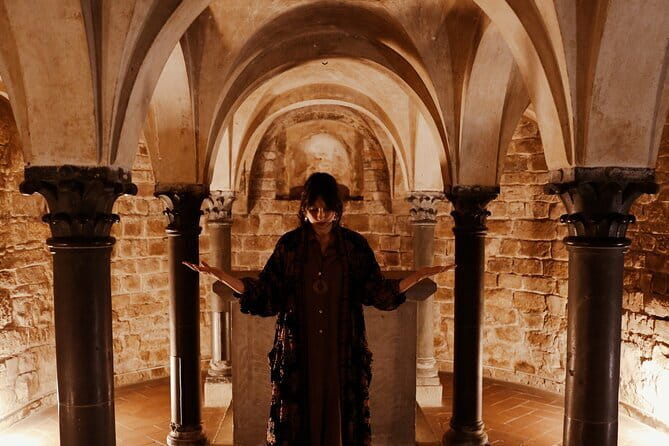
Your final stop is Basilica di Santa Trinita. After walking through what you could call the real, not-touristy Florence, you conclude inside the church.
The best part here is the atmosphere shift. Outside, you are in streets and squares. Inside, you get silence and medieval calm, a holy place where the city’s noise can’t follow you in.
This stop is about 10 minutes, and admission is included. It’s not a long church crawl. It’s a focused finish that helps the tour land emotionally. If you’ve been learning about art, faith, and Florence’s civic identity all along, the church interior is a natural place to absorb it.
Practical tip: churches often mean cooler air and dimmer lighting. Wear clothes you can stand in for a few minutes, and be ready to look more slowly than you did outside.
What you actually learn on this walk (not just what you see)

What makes this tour worth your time is the way the guide connects locations into a story you can carry with you after you leave.
Here are the themes you will feel as you go:
- Art as city identity, starting with Santa Croce and the introduction to Florence’s beauty and symbolism
- Religion as a public experience, not a separate world, especially when you move toward the basilica finish
- Literature tied to place, through Dante’s district and Beatrice
- Social power in medieval life, with the discussion around the role of women
Camilla’s style, from what you can tell in how people praise the tour, is more than delivering facts. She clearly loves what she does and explains with enough clarity that the city’s art feels more meaningful instead of just impressive.
That’s the difference between a tour where you collect photos and a tour where you collect understanding.
Group size and how it feels in practice
With a maximum of 15 travelers, you should expect a small-group vibe. That size is big enough that logistics are workable, but small enough that you are not swallowed by the crowd.
Because each stop is timed in short blocks, the guide can keep the group moving and still pause for relevant discussion. You are not stuck for long periods standing in front of one wall. You get the feeling of being carried from scene to scene.
Also, since it’s a walking tour with good access to public transportation near the start and end points, it’s easy to plan around. You can tack this onto a day without needing a complicated transportation setup.
Best moments for different kinds of travelers
This tour tends to fit best when you answer yes to most of these:
- You want Florence in under 3 hours but without racing through everything famous
- You enjoy learning from an art historian guide, especially when religion and art intersect
- You like walking between places that feel connected, not random additions
- You prefer quieter areas and short explanations over long museum detours
If you are someone who needs a strict checklist of must-see monuments and you have zero interest in social and literary context, you might feel this tour is more “thinking walk” than “see everything” sprint.
Before you book: what to prepare mentally
Two practical things to set expectations:
- This experience requires good weather. If it’s not good, it can be rescheduled or you can get a full refund. Plan with backup days if you can.
- It’s roughly 2 hours of walking, so comfortable shoes matter.
One more small note: the tour includes admission tickets at the stops noted in the route. Still, it’s smart to arrive with a flexible mindset, because church schedules and the feel of sacred spaces can affect how you experience interiors.
Should you book this Florence tour with Camilla?
I would book this if you want Florence to feel personal and explainable, not just photographed. The combination of Camilla’s art history approach, a route that focuses on medieval squares and churches, and the thoughtful stop structure makes it a strong use of a short visit.
I would skip it if you are mainly after the biggest headline sites, or if you dislike walking in changing weather. At $610, you want to be sure you are paying for interpretation and atmosphere, not just convenience.
If you want a quieter Florence with context, and you like religious sites explained as part of the city’s culture, this is an excellent match.
FAQ
How long is the tour?
The tour is approximately 2 hours.
Where does the tour start and end?
It starts at Piazza di Santa Croce, 13, 50122 Firenze FI, Italy, and ends at Basilica di Santa Trinita, Piazza di Santa Trinita, 50123 Firenze FI, Italy.
Is this a small-group tour?
Yes. The tour has a maximum of 15 travelers.
What is included during the experience?
Admission tickets are included for the stops on the route, and you receive a mobile ticket.
Is it possible to participate if I’m a typical visitor?
Most travelers can participate, since it is a walking tour.
What if the weather is bad?
This experience requires good weather. If it’s canceled due to poor weather, you’ll be offered a different date or a full refund.
Just reviewed around Florence
- Sculpture in Florence : Traditional Clay modelling class★ 5.0 · 12 reviews
- Art and History in Florence: Small Group Walking Tour★ 5.0 · 25 reviews
- Exclusive Cinque Terre Day Trip from Florence★ 5.0 · 102 reviews
- Florence treasures on a city bike – 1 day rental –★ 5.0 · 25 reviews
- Private Tour to Cinque Terre in English, Español and Purtuguês★ 5.0 · 3 reviews
- Full-Day Small-Group Cinque Terre Tour from Florence★ 4.5 · 58 reviews
- Cinque Terre Vibes with Postcard Perfection and Lunch Treats★ 5.0 · 3 reviews
- Cinque Terre Private with the leaning tower Pisa from Florence★ 5.0 · 9 reviews